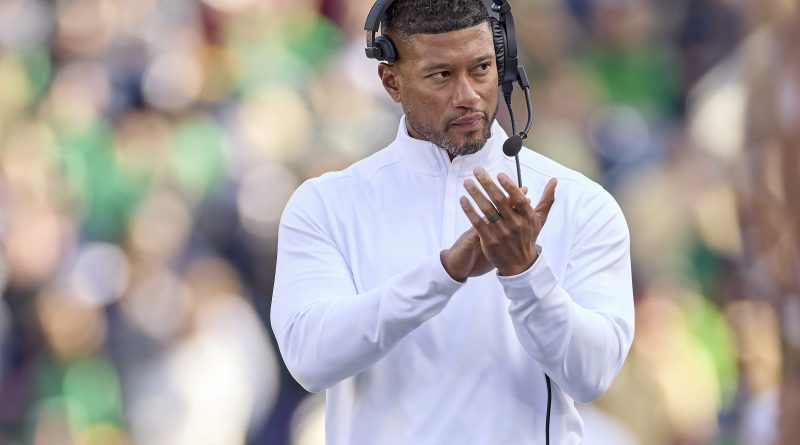
Notre Dame leads wave of teams declining bowl invitations in unprecedented postseason shift
By NORAL PARHAM
The 2025 college football postseason has arrived with a historic jolt, not from the games themselves, but from the teams refusing to play them.
In a shift that signals a new era for the sport, at least 10 programs — including the University of Notre Dame—have declined invitations to participate in bowl games this winter.
The mass exodus includes three bowl-eligible teams and a host of programs that would have qualified based on Academic Progress Rates (APR) to fill vacancies. While player opt-outs have become increasingly common in recent years, the withdrawal of entire programs from postseason consideration marks a significant departure from tradition, driven by the expanding College Football Playoff (CFP), coaching turnover, and the transfer portal.
Notre Dame’s Playoff Snub and Subsequent Withdrawal
Leading the headlines is Notre Dame, which finished the regular season 10-2 but found itself on the wrong side of the playoff bubble. Despite a 10-game winning streak to close the year, the Fighting Irish were ranked No. 11 in the final CFP poll, effectively bumped out by conference champions and at-large bids given to Miami and Alabama.
Following the bracket release, the university promptly announced it would not accept a bid to a non-playoff bowl game, reportedly rejecting an invitation to the Pop-Tarts Bowl in Orlando to face BYU.
“As a team, we’ve decided to withdraw our name from consideration for a bowl game following the 2025 season,” the program said in an official statement released on social media. “We appreciate all the support from our families and fans, and we’re hoping to bring the 12th national title to South Bend in 2026.”
For Notre Dame, the decision underscores a “championship or bust” mentality. Without a conference championship game to boost their resume, the independent Irish were left idle during championship weekend, watching their playoff hopes evaporate as other results unfolded.
Big 12 schools opt out amid coaching changes
The trend extended to the Big 12, where both Iowa State and Kansas State declined postseason opportunities despite earning six or more wins. Unlike Notre Dame, these decisions were heavily influenced by coaching stability and roster availability.
Both programs are navigating significant leadership transitions. Matt Campbell departed Iowa State for Penn State, leaving the Cyclones in flux, while Kansas State is managing the retirement of head coach Chris Klieman.
“This decision was not taken lightly, but with our coaching staff transition and several uncertainties regarding player availability, I felt it was not in our best interest to try to field a team that was not representative of Kansas State University,” Kansas State Athletic Director Gene Taylor said.
Iowa State Athletic Director Jamie Pollard echoed similar sentiments regarding his program, noting that the administration respected the players’ vote to end the season. “Our student-athletes have had an incredible season and we are grateful for their leadership as we worked through this process with them,” Pollard stated.
However, the decision came with a steep price tag. The Big 12 Conference announced it would fine both Iowa State and Kansas State $500,000 each for failing to fulfill their contractual bowl obligations. “While the conference acknowledges the difficult timing around coaching changes, the Big 12 is responsible for fulfilling its contractual obligations to its bowl partners,” the league said in a statement.
A ripple effect across the NCAA
The refusals created a logistical scramble for bowl organizers, who needed to fill 82 slots. Typically, when there are not enough six-win teams, 5-7 teams with high APR scores are invited to fill the gaps. This year, however, even those opportunities were largely rejected.
Reports confirm that multiple 5-7 programs, including Florida State, Auburn, UCF, Baylor, Rutgers, and Temple, turned down invitations.
For Auburn, the decision was tied to a new era under incoming head coach Alex Golesh. “Coaching change, staff building, roster retention, players in offseason mode — a bowl trip simply wouldn’t make sense,” reported On3 regarding the Tigers’ decision.
Florida State head coach Mike Norvell also confirmed that his team would not accept a bid following a brutal 5-7 campaign, instead choosing to focus entirely on offseason reconstruction.
The future of “Bowl Season”
This wave of team-wide opt-outs raises serious questions about the viability of the traditional bowl system in the 12-team playoff era. For decades, a bowl game was viewed as a reward—a celebratory capstone to a season and an opportunity for extra practice. Today, for programs outside the playoff bracket, the risks of injury and the urgency of roster retention via the transfer portal often outweigh the benefits of a mid-tier exhibition game.
As the 2025 season concludes, the focus for these ten teams has already shifted to the 2026 season. Whether this becomes a permanent trend remains to be seen. However, the message from athletic departments across the country is clear: the definition of a successful season is evolving, and the allure of a non-playoff bowl game is waning rapidly.
Noral Parham is the owner of Horsemen Sports Media. Parham is also the Senior Sports Reporter for the Indianapolis Recorder. For more news, click here.
